

Routine scale maintenance is more than cleaning. Inspections, load cell testing, and environmental checks catch failures before they stop production.
When a scale goes down mid-shift, the cost is rarely the repair. It is the loadout that stops, the batch that cannot be released, and the trucks that queue while someone finds a technician.
Almost all of it is avoidable. Scales are precision instruments in industrial environments, and they fail in patterns that routine service is very good at catching early.
Why Scales Drift and Fail
Weighing equipment does not usually break suddenly. It degrades in ways that are easy to miss until the day it stops.
Mechanical wear accumulates in load cells, mounting hardware, and levers under repeated loading. Environmental exposure — temperature swings, humidity, dust, washdown chemicals, vibration from nearby equipment — works on seals and connections continuously. Physical damage from an overloaded platform or a forklift impact can shift a scale out of tolerance without leaving an obvious mark.
The common thread is that the scale usually keeps producing readings the whole time. It just stops producing correct ones, and nothing announces the change.
What Routine Scale Maintenance Includes
Maintenance is often assumed to mean cleaning and a calibration check. A proper service visit covers considerably more.
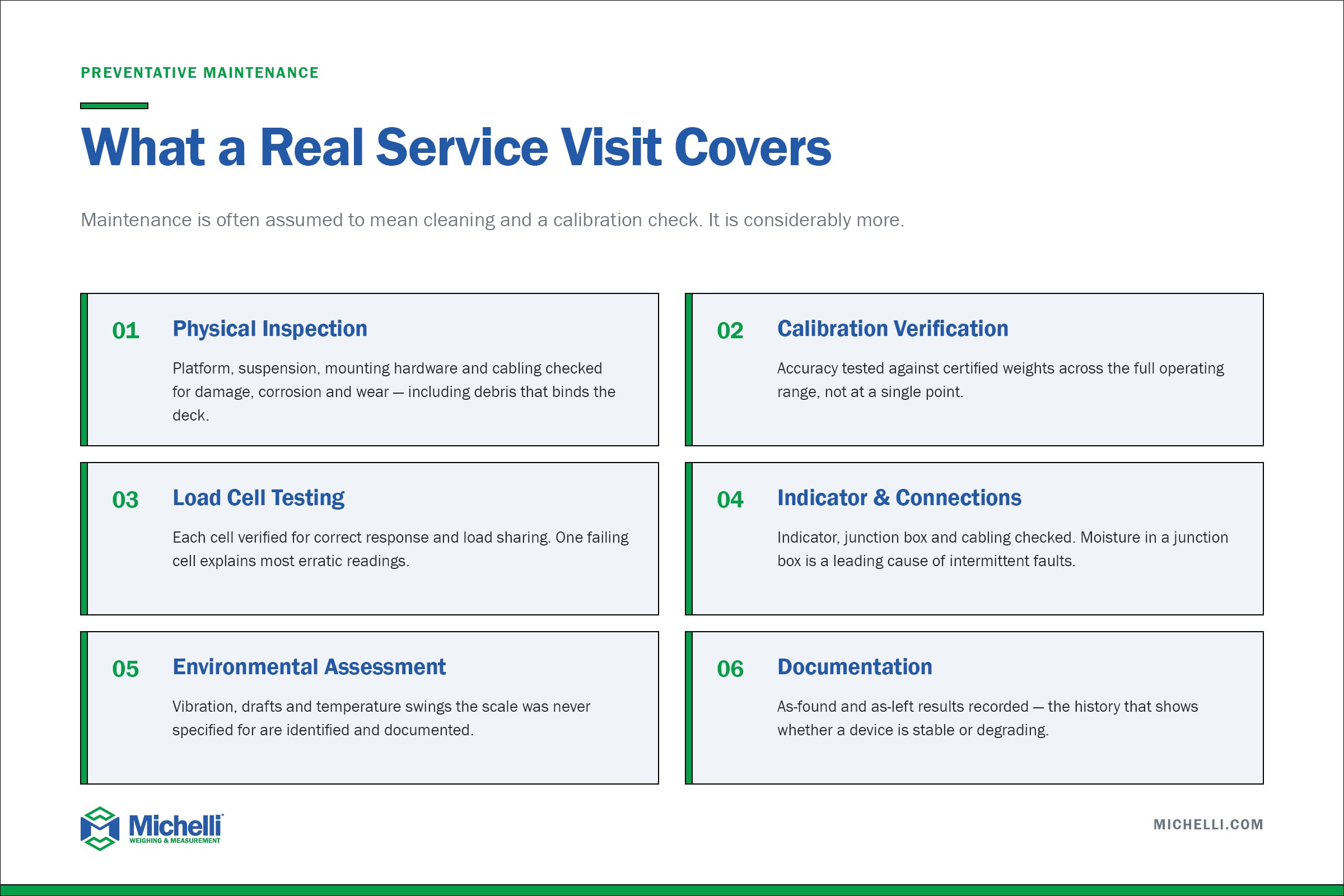
Physical Inspection
Checking the platform, suspension, mounting hardware, and cabling for damage, corrosion, and wear — including the debris under and around a floor or truck scale that binds the deck and quietly changes readings.
Calibration Verification
Testing accuracy against certified weights across the operating range, not just at one point. A scale can be accurate at 500 lb and out of tolerance at 5,000 lb, which single-point checks miss entirely.
Load Cell Testing
Verifying each cell is responding correctly and sharing load as designed. On a multi-cell scale, one failing cell is often the root cause of readings that seem randomly inconsistent depending on where material sits on the deck.
Indicator and Connection Checks
Confirming the indicator, junction box, and cabling are sound. Moisture in a junction box is one of the most common causes of intermittent faults, and one of the easiest to catch early.
Environmental Assessment
Identifying conditions affecting performance — vibration from newly installed equipment, a new draft from a relocated door, temperature swings the scale was never specified for. How Extreme Environments Impact Scale Accuracy covers these effects in more detail.
Documentation
Recording as-found and as-left results. Beyond compliance, this history is what tells you whether a device is stable or steadily degrading — the difference between a scale that needs a schedule and one that needs replacing.
The Real Cost of Skipping It
Deferred maintenance does not remove cost. It moves it, and usually increases it.
Emergency service costs more than scheduled work and arrives on its own timeline rather than yours. Production stoppages ripple outward — an inoperable truck scale can back up an entire loadout. Inaccurate readings cost money quietly for as long as they go undetected, in overfilled product or disputed tickets; our inaccuracy cost calculator puts a figure on that. And shortened equipment life turns a maintainable asset into a capital replacement years early.
Setting a Schedule That Fits
The right interval depends on duty cycle, environment, and regulatory requirements. A truck scale running continuously in an outdoor yard needs far more frequent attention than a bench scale in a climate-controlled room — and seasonal conditions matter too, as Winter Truck Scale Maintenance covers.
Start with the manufacturer’s recommendation and your compliance obligations, then let your service history refine it. Equipment that comes back in tolerance every visit may support a longer interval. Equipment that drifts needs to be seen more often — and that pattern is worth acting on before it becomes a failure.
Michelli: Your Precision Partner
With over 75 years of experience and 50+ locations across 18 states, Michelli Weighing & Measurement builds preventative maintenance plans around your operation and schedule. Our certified technicians also provide calibration services, equipment and scale repair, and weighing systems service when something does need attention, and our TRAC Asset Management System keeps the full service history in one place.
Ready to stop reacting to failures? Contact us to set up a maintenance schedule that fits how you actually operate.
